
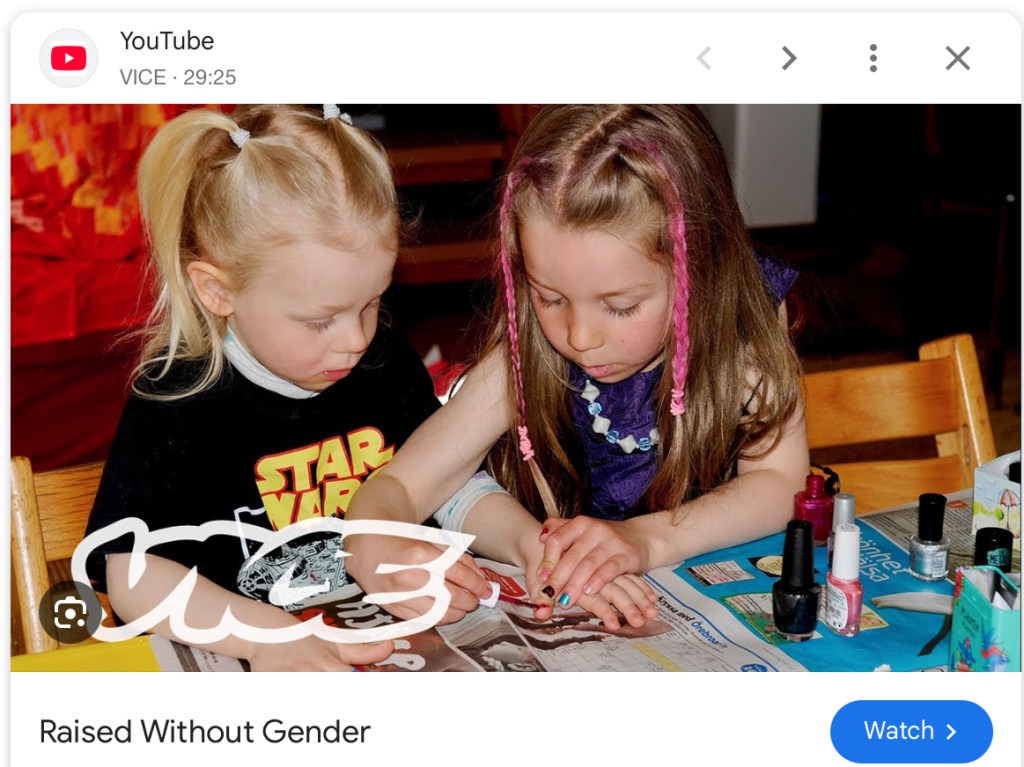
In a world where traditional gender norms are being questioned, and transgender individuals more than ever under attack, parents and educators are looking for new ways to promote inclusivity, expand children’s opportunities regardless of their gender, and support them in exploring their identities freely. It is in this atmosphere that the concept of genderless child-rearing has emerged, to offers a promising approach to breaking free from the confines of the gender binary. In this blog post, I examine this innovative approach, its potential benefits in allowing children to express themselves authentically, and also its limitations. My reflection is based on the YouTube documentary “ Raised without Gender ” (VICE, 2019).
About The Documentary
The documentary offers an overview of Sweden’s progressive approach to countering gender stereotypes. In Sweden, the gender neutral pronoun “hen” has been incorporated in the traditional dictionary since 2015 and well adopted by its population. The Swedish government is also a pionneer in terms of legistration. For example it has forbidden the enforcement of gender stereotypes in school and funded gender neutral kindergarden. Essentially, the documentary centers its narrative around Mapa Del LaGrace Volcano, who candidly speak about their family and non-conforming approach to raising their kids. The documentary also provides insight into the Gender-Aware Kindergarten and their approach to deleting gender norms from education.
Children and the development of Stereotypes:
Gender norms have created a binary system that restricts children’s roles, expressions, realities, and opportunities based solely on their external genital appearances. Social learning perpetuates these norms, and children begin to learn them as soon as they are exposed to social interactions, culture, and media representations. This not only affects children’s reality and worldview but also contributes to the formation of gender stereotypes. Research shows that children adopt these stereotypes as early as 2 years old, which raises concerns about how this affects their inner sense of self and identity development. Gender norms ignore the complexities of being human and limit children’s freedom to explore their authentic selves.
Genderless Child-Rearing: Countering Stereotypes and nurturing authenticity
In the documentary video, the Gender-Neutral Kindergarten has implemented strategies to break free from the tyranny of the gender binary. Through play, formal learning, and positive role modeling, children are encouraged to explore their gender identity. The kindergarten has been successful in their efforts to eliminate gender-based play. Children are also exposed to gender-neutral toys, environment, and stories. For instance, the Kindergarten challenges gender norms by portraying masculine superheroes in traditionally feminine roles. Additionally, the Kindergarten refers to the Disney story Sleeping Beauty to reinforce the importance of consent, as Sleeping Beauty said « no. » It was a refreshing experience to observe children of all genders engaging in various types of play without any gender-based restrictions. Parents who have already adopted the genderless child-rearing approach find it comforting that their kids attend formal environments that share their values. They feel that their kids will continue to learn and immerse themselves in these concepts outside of the home. As for inside their homes, the way parents break free from gender norms is by encouraging self-socialization in their children. They allow their children to develop a sense of self by exposingthem to multiple gender identities without explicit instruction or guidance. Then, they engage in personal exploration, observation, and reflection and compare their inner sense of self to what society reflects to them. The interaction of both internal and external factors contributes to their understanding of their own gender identity.
Mika, the eldest child of Mapa, is an example of how supportive parenting can facilitate a child’s exploration and acceptance of their gender identity. Research suggests that children typically develop a clear sense of self around the age of four, and Mika, who is almost five and a half years old, exemplifies this developmental milestone. Despite being pressure several times to choose a gender, Mika consistently refers to themselves as both genders, which indicates a strong sense of identity that may align with being gender fluid or gender-neutral. This self-assured expression of gender identity is further reinforced by Mika’s parents, who have created an environment that values choice and freedom. Mika’s parents not only respect but also affirm their child’s choices, allowing for example, Mika to gravitate towards toys and clothing that feel authentic to them. By encouraging Mika’s self-expression and identity exploration, Mapa play a pivotal role in fostering a sense of belonging and acceptance within the family unit. Ultimately, Mika’s journey highlights how impactful is supportive parenting in nurturing a child’s authenticity.
Critiques and Limitations
Doctor Edberhard was the only person who questioned the approach of gender-neutral kindergarten. He argued that this approach was damaging because it made typical behavior for boys or girls seem problematic. In my opinion, he had a point. I felt slightly uncomfortable while watching the video when the interviewer asked if the dolls on the shelf had a gender. The daycare staff replied by showing the absence of genitals on the doll, which could suggest an amalgamation between sex and gender. Additionally, the kindergarten staff mentioned that they ensure children do not differentiate between boys and girls, but instead refer to everyone as « friends » and « people. » While I agree with the idea of gender inclusion, I partly align with Dr. Edberhard’s critics that boys and girls categories should not be erased. True gender inclusion should also be inclusive of the categories of boys/men and girls/women. However, I only slightly agree with Dr. Edberhard since he further stated that the gender-neutral kindergarten was attempting to eradicate sex differences, which I do not particularly agree with. I am not sure if this comment was a sign of confusion between the concepts of sex and gender. I found his comment to be contradictory since sex differences are biological and, therefore, part of human nature, and cannot be erased through socialization.
Eliminating the categories boys and girls may equally limits the expression of children who strongly associate with being a boys or being a girl and may be internalized that it is a wrong thing which is exactly what the gender binary is doing with gender non conforming categories. And that it is important that there is no shame associated with these categories the same way we demand it for non binary or trans kids.
Now what is the path forward?
Moving forward, I believe the path lies in inclusive reality and de-hierarchize of gender. Striking a balance between eradicating stereotypes while honoring individual identity is not an easy balance to strike, but it’s a journey worth embarking on. The increasing number of people challenging the gender binary gives me hope for a more inclusive and accepting future. Change is a process that requires experimentation and learning from mistakes, but the willingness to engage in these discussions and push boundaries is in itself a positive step forward.
–
REFERENCES :
Gelman, S. A., & Meyer, M. (2011). Child categorization. Wiley interdisciplinary
reviews. Cognitive science, 2(1), 95–105. https://doi.org/10.1002/wcs.96
Martin, C. L., & Ruble, D. N. (2010). Patterns of gender development. Annual
review of psychology, 61, 353–381.
VICE. (2019, November 25). Raised without gender [Video file]. YouTube.
 uninstantdemoi.com
Laisser un commentaire